Fill all information details to consult with us to get services from us
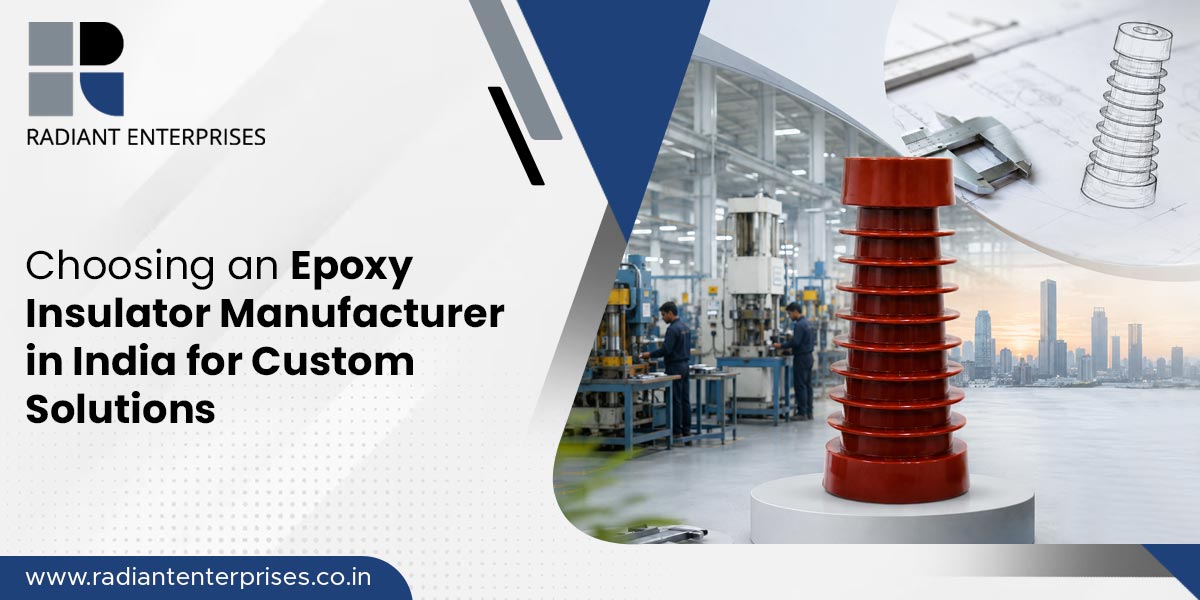
Choosing between Epoxy insulators manufacturers in India can feel harder than expected. A sample may look right, yet questions remain about fit, strength, safety, and long-term use. Many people tell us that these doubts grow when a standard product cannot meet a new design. At Radiant Enterprises, we understand that concern. We know you aren’t buying a simple moulded part. You’re trusting one part to protect a much larger electrical system.
It usually starts with something small. A hole position needs changing, space inside the panel feels tight, or an old part keeps failing. At first, the change may seem easy. Once voltage, load, heat, and mounting pressure enter the discussion, the need becomes much clearer.
When you approach an Epoxy insulator manufacturer in India, you should feel heard from the first talk. We begin by asking where the insulator will sit and what stress it may face. We also discuss voltage, load, size, fittings, temperature, and working conditions. These details help us understand the real need before we suggest a shape or material.
At Radiant Enterprises, we don’t believe a drawing tells the full story. Two parts with the same size may face very different working conditions. One may support a busbar inside a panel. Another may work near heat, dust, or strong electrical fields. We look beyond dimensions because a small missed detail can cause trouble later.
Ready-made parts work well when the design and operating needs are common. But many switchgear, panel, transformer, and railway projects have tight spaces or special mounting needs. A standard part may force you to change the main assembly. That can add cost, delay work, and create fresh design risks.
A capable Epoxy insulator supplier in India should help you avoid forced changes. We can review drawings, samples, load needs, and the space around the part. This gives us a clear base for the design. It also helps us spot sharp edges, weak points, or fitting issues before mould work begins.
We’ve seen this happen often. A team orders a part based only on height and voltage. During assembly, the insert angle feels wrong or the base blocks another part. Rework then starts, even though the insulator itself looks fine. At Radiant Enterprises, we try to prevent these moments through careful review before production.
You don’t need a perfect brief before speaking with us. Even a rough drawing or old sample can begin the discussion. Still, a few details help us reach the right answer faster:
Good epoxy material matters, but material alone cannot ensure good performance. Mixing, vacuum casting, curing, insert placement, and mould control also affect the final part. Poor control may leave air gaps, uneven surfaces, hidden cracks, or weak bonding near metal inserts.
When reviewing the Best insulator manufacturers in India, ask how production quality stays steady across each batch. We control key stages rather than waiting for the final test to reveal a problem. At Radiant Enterprises, our aim is to build quality into the process, from raw material checks through moulding and final review.
Most people don’t connect curing with future failure. Yet poor curing can affect strength, surface finish, and heat response. Air trapped inside the casting may also weaken electrical use. This is why clean moulds, controlled mixing, vacuum treatment, and a stable curing cycle deserve real attention.
A test report has value only when the test suits your use. An indoor support insulator does not face the same conditions as an outdoor part. A busbar support may need strong mechanical performance, while another part may face greater electrical stress. We choose checks based on the product and agreed needs.
A trusted Epoxy insulator exporter in India must also understand that overseas buyers may follow different test plans. Voltage levels, inspection steps, packing rules, and documents can change between projects. We discuss these points early, so approval and dispatch don’t become rushed tasks at the end.
At Radiant Enterprises, we can plan checks around dimensions, surface finish, inserts, electrical strength, and mechanical needs. Applicable standards and buyer-approved test plans guide the process. We also keep records where the project calls for batch checks or part tracking.
A good discussion can tell you more than a polished brochure. We suggest asking direct questions and listening for clear answers:
A sample is not just a smaller order. It gives you a chance to check fit, alignment, handling, and assembly before full production. Maybe a metal insert needs a slight shift. Perhaps the base needs more clearance. Finding this during the trial stage is far less painful than finding it after hundreds of parts arrive.
Working with an Epoxy insulator manufacturer in India should give you room to test and improve. At Radiant Enterprises, we treat sample feedback as part of the design process. We review what worked, what felt wrong, and what must change before regular production starts.
This stage also builds trust. You can see how we respond when a change is needed. We can learn more about your assembly and the people handling the part. That shared understanding often leads to a better product and fewer questions during later orders.
Once an insulator passes testing, the next concern is repeat supply. You need each batch to match the approved part. Changes in shade, dimensions, inserts, surface finish, or strength can disturb assembly and slow production.
A dependable Epoxy insulator supplier in India should maintain drawings, approved samples, inspection needs, and order records. We use these details to support steady output at Radiant Enterprises. Clear records also help when an old order returns after several months or a new quantity must match an earlier batch.
Price matters, but the lowest quote can become costly when parts need sorting or rework. Delayed dispatch can also hold up a full panel or switchgear order. We believe the right price should include careful work, honest lead times, useful support, and steady quality.
An insulator may pass every test and still arrive damaged through poor packing. Metal inserts can strike nearby parts, cast edges can chip, and moisture can affect outer cartons. Export packing must suit the part, shipment method, and distance.
As an Epoxy insulator exporter in India, we plan packing with the same care used during production. We consider part separation, surface protection, carton strength, labels, and handling needs. Radiant Enterprises also works with buyers on packing lists and agreed product documents.
Clear updates matter during export orders. You should know when samples are ready, when production begins, and when dispatch is planned. Silence creates stress, especially when another assembly depends on the shipment. We prefer simple and timely updates that help you plan with confidence.
Many Epoxy insulators manufacturers in India can offer a catalogue and a price. The real difference appears when your design does not match the catalogue. Can we study the problem, discuss options, explain limits, and support changes without making the process difficult?
At Radiant Enterprises, we see custom work as shared work. We bring our casting knowledge, while you bring the real needs of your system. When both sides speak openly, small risks become easier to catch. The final part also becomes easier to approve and use.
The Best insulator manufacturers in India should never make you feel rushed into a choice. We encourage you to compare design support, process control, testing, sample work, supply strength, and communication. These points may not appear in the lowest quote, but you’ll feel the value during production.
Maybe you have a drawing ready. Maybe you only have an old part, a failed sample, or a tight space inside a panel. Any of these can start a useful talk. We can review the need, ask clear questions, and help shape the next step.
Choosing an Epoxy insulator manufacturer in India becomes easier when you feel understood. Radiant Enterprises brings practical support from early design talks through testing and supply. We don’t promise that every request has a quick answer. We promise to study it with care, speak honestly, and work towards a solution that fits your application.
Check design support, moulding skill, test plans, quality checks, sample options, and delivery history. Choose a manufacturer who first understands your actual use.
Share voltage, load, size, mounting method, insert details, working temperature, end use, and order quantity. A drawing or old sample also helps.
Yes, a manufacturer can study your sample and prepare a matching design. Final size, material, inserts, and test needs should be approved before production.
Tests may cover dimensions, electrical strength, mechanical load, surface finish, inserts, and heat resistance. The final test plan must match your application.
Lead time depends on design work, mould making, sample checks, testing, and order size. Ask for a clear schedule before approving the order.
Air gaps may form during poor mixing, casting, or curing. Vacuum casting and process control help reduce hidden gaps that may weaken electrical performance.
Epoxy insulators can handle heat within approved limits. Material grade, fillers, curing, nearby parts, and working conditions all affect safe service temperature.
Some epoxy grades suit outdoor use, but sunlight, rain, dust, moisture, and pollution need review. Confirm the material and test plan before ordering.
Cracks may result from excess load, poor curing, sharp design points, wrong inserts, heat changes, or rough fitting. A design review reduces these risks.
Yes, sample approval helps check fit, size, insert position, finish, and assembly. It can prevent costly changes after full production has already started.
Compare material grade, mould cost, tests, inspection, packing, lead time, and support. A low price may exclude checks needed for safe use.
Confirm drawings, test needs, packing, labels, documents, delivery dates, and sample approval. Clear terms help avoid damage, delays, and costly order disputes.