Fill all information details to consult with us to get services from us
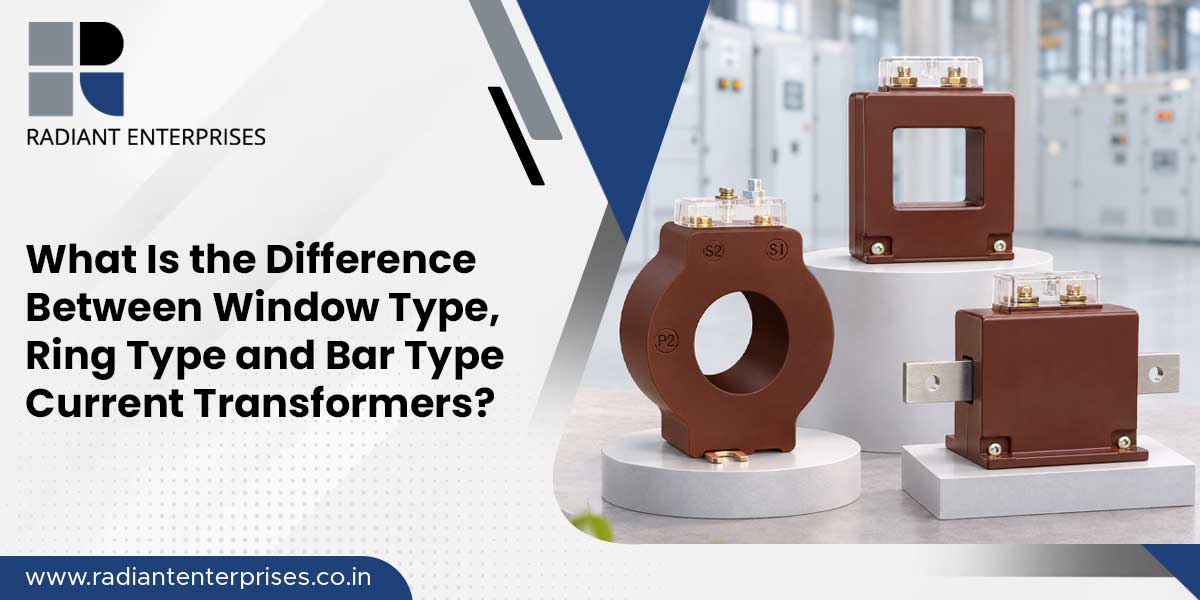
You have checked the panel drawing, yet three CT names still leave you unsure what to order. We understand the concern: a small mismatch can hold up wiring and put pressure on your delivery date. At Radiant Enterprises, we work as your Current transformer supplier in India to help you match the design to your equipment. Before comparing prices, we want you to feel clear about what each name means.
We should start with one detail that often gets lost in product lists. Window type and ring type are not always separate designs. We use “window” to describe an opening through which your existing cable or busbar passes. “Ring” usually describes a circular core around that opening.
With a bar type CT, we have a primary conductor built into the unit. That built-in bar connects into your main circuit. We therefore need to check construction drawings rather than assume three product names describe three distinct working principles.
Across these designs, we use magnetic induction to produce a smaller current for meters or protective relays. We select the core and winding for the required duty. We cannot judge accuracy, voltage suitability or fault performance from the outer shape alone.
When your panel already has a planned cable or busbar route, we start by checking the available opening. A window CT fits around that conductor, which acts as the primary winding. We do not need a separate primary bar built into the CT.
At Radiant Enterprises, we look beyond whether a cable will physically pass through. We also check insulation needs, mounting space and access to secondary terminals. You should not discover during assembly that the opening fits but the terminal cover cannot be reached.
For a closed-core window CT, we need access to pass the conductor through during assembly. With an existing connected circuit, that affects the work schedule. We assess whether a suitable split-core design would make a retrofit more practical, under proper isolation procedures.
As a Ring type current transformer supplier in India, we help you check the bore size against your cable arrangement. At Radiant Enterprises, we also review the required ratio and mounting details. A neat circular shape alone tells us little about suitability for your panel.
We must also distinguish phase measurement from residual-current sensing. For phase current, we normally pass the relevant phase conductor through the opening. For residual-current sensing, we follow the approved wiring arrangement for the circuit conductors and relay. We never choose the arrangement from appearance alone.
Here, we supply a CT with a built-in primary bar forming part of the assembly. We connect the supply and load to the bar ends, using the specified joints. Unlike a window unit, we are not simply passing your separate conductor through an empty opening.
As a Bar type current transformer manufacturer in India, we review the bar connections alongside your switchgear layout. At Radiant Enterprises, we check dimensions, mounting and insulation requirements against the agreed design. We want assembly details settled before your panel reaches the wiring stage.
We also check how your design supports the unit and handles forces during a fault. A bar type CT is not automatically more accurate than a ring or window model. We compare the stated ratings and test requirements for the same intended duty.
When you are weighing up an Industrial current transformer in India, we suggest comparing the current path first. We can then review the fit without getting distracted by product names. These three checks give us a useful starting point:
At Radiant Enterprises, we use your drawing to resolve differences that photographs cannot show. We need the overall dimensions, terminal positions and mounting details alongside electrical ratings. This gives you a clearer basis for approval than choosing whichever housing looks most familiar.
We know how tempting it feels to match the current ratio and move straight to pricing. A 400/5 A rating, for example, means a nominal 5 A secondary output at 400 A primary current. We still need to confirm compatibility with your meter or relay.
As your Current transformer supplier in India, we check the secondary rating, accuracy class and connected burden together. Burden includes the meter or relay and the connecting leads. We need that total load to fall within the conditions covered by the specified accuracy rating.
For metering, we focus on useful accuracy across the expected operating range. For protection, we assess performance at fault currents and the risk of core saturation. At Radiant Enterprises, we help you review both duties before agreeing on a design.
When sourcing an Industrial current transformer in India, we encourage you to share the actual panel conditions early. We need more than the current rating: ambient heat, system voltage and fault levels affect selection. You also need enough room for safe wiring and future checks.
As a Ring type current transformer supplier in India, we ask for cable dimensions and the required opening before confirming fit. We also check whether assembly access suits a closed-core unit. This helps you avoid finding an access problem after cable termination.
As a Bar type current transformer manufacturer in India, we ask for bar dimensions, connection details and mounting drawings. We check these details against your assembly plan so you can approve the connections before manufacture. Clear drawings save repeated calls when workshop time is already tight.
We want you to leave this comparison with one clear distinction: separate conductor or built-in primary bar. Window and ring names often overlap, so we confirm the actual construction. We then match the ratings to your measurement or protection needs.
We also keep safe handling central to the discussion. Never leave a conventional CT secondary open while primary current flows; dangerous voltage can develop. We require qualified personnel to follow approved isolation, shorting and earthing procedures during testing or maintenance.
At Radiant Enterprises, we manufacture and supply current transformers alongside our insulators and bushings. Share your drawing, duty and ratings with us. We can review the details together and help you approve a unit that fits your equipment and your working needs.
Window CTs accept a separate conductor through an opening; ring CTs commonly share this design. Bar CTs include a built-in primary conductor connected into the circuit.
The terms often overlap. Ring type usually describes a circular core, while window type describes the opening through which the primary conductor passes.
Choose a bar type CT when your equipment design calls for an integral primary conductor. Confirm connection dimensions, insulation ratings and mounting requirements before ordering.
Neither design is automatically more accurate. Compare the accuracy class, operating current range and specified burden rather than judging performance by the housing shape.
A suitable split-core CT can fit around an existing cable without removing its termination. Qualified personnel must still follow approved isolation and installation procedures.
Check the cable’s outer diameter or busbar dimensions against the clear opening. Allow for insulation, mounting clearance and the conductor arrangement shown on your drawing.
Burden is the electrical load connected to the CT secondary, including instruments and leads. Incorrect burden can affect accuracy and protective relay performance.
Only when the specified core or separate cores meet both duties. Metering accuracy and fault-current performance require different checks; a matching ratio alone is insufficient.
A 400/5 A CT produces a nominal secondary current of 5 A at 400 A primary current. Your connected meter or relay must accept that rating.
An open secondary can develop dangerous voltage while primary current flows. Qualified personnel must use approved isolation and shorting procedures before disconnecting meters or relays.
Yes. Radiant Enterprises manufactures customised current transformers based on the required ratio, burden, accuracy class and mounting arrangement, helping you address panel space and fitting needs.
Send Radiant Enterprises the ratio, secondary rating, accuracy class, burden, voltage, fault rating, dimensions, mounting drawing, intended duty and quantity to support a suitable quotation.