Fill all information details to consult with us to get services from us
A post insulator rarely gets much attention until something goes wrong. Heat, moisture, dust, or pollution can slowly weaken electrical insulation. At Radiant Enterprises, we understand how worrying these hidden risks can feel. As one of the best epoxy bushing manufacturers in India, we help you choose insulation based on real working conditions, not assumptions.
Many people tell us that post insulators look simple from the outside. Yet each unit carries electrical stress while supporting heavy conductors and equipment. A poor choice can lead to leakage current, surface damage, flashover, or an unplanned shutdown.
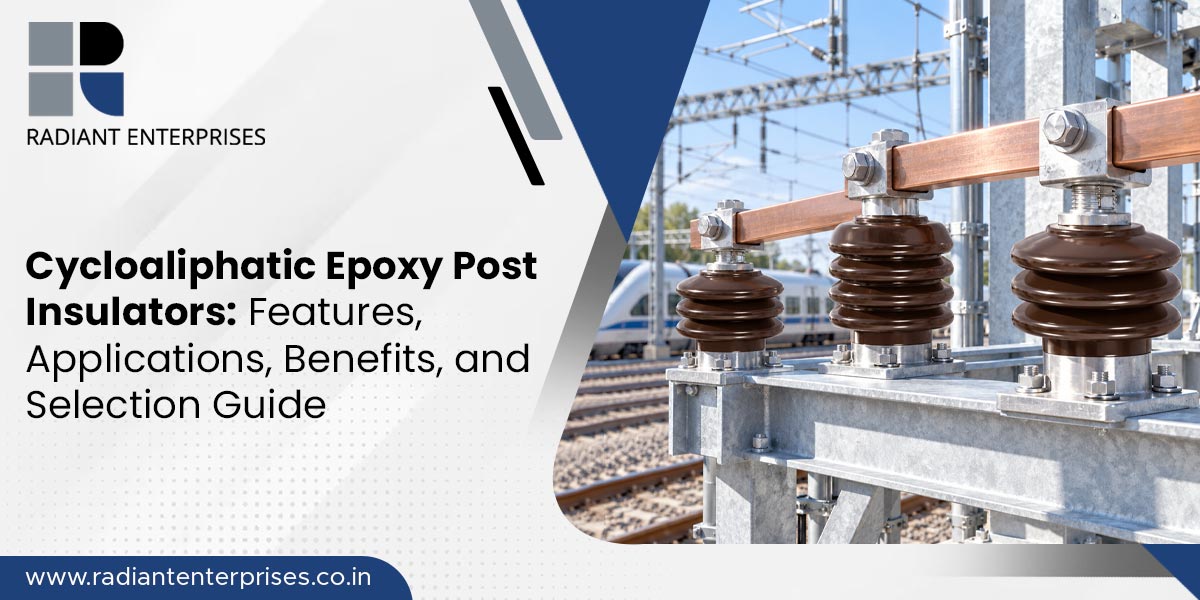
A cycloaliphatic epoxy post insulator is a solid support used within electrical systems. It provides electrical insulation while holding busbars, conductors, switches, and other live parts firmly in place.
The material is made from a special epoxy resin designed for electrical use. Its molecular structure offers good resistance to sunlight, moisture, heat, and surface tracking. This makes the material suitable for harsh indoor areas and many outdoor sites.
At Radiant Enterprises, we assess voltage, load, climate, and installation space before suggesting a design. As a cycloaliphatic epoxy insulator supplier in India, we support projects that need strong insulation with a compact build.
Unlike porcelain, epoxy can be moulded into detailed shapes with embedded metal parts. This helps reduce separate joints and supports accurate fitting during assembly. The finished insulator is also lighter, which can make handling much easier.
At first, it may seem that every electrical insulation material does the same job. We’ve seen this thought lead to early wear and avoidable faults. Material choice affects how an insulator reacts to water, sunlight, dirt, electrical stress, and impact.
Cycloaliphatic epoxy offers a useful mix of electrical and physical strength. The material can resist surface tracking when its grade, shape, and production process suit the site. It also performs well where regular moisture or dust may reach the surface.
As a trusted post insulator supplier in India, Radiant Enterprises pays close attention to resin quality and moulding control. Small faults, such as air gaps or weak bonding, can affect long-term service.
No material should be chosen by name alone. The compound, shed profile, creepage distance, inserts, and test needs must work together. Site conditions should always guide the final choice.
A data sheet can feel confusing when many values appear together. We suggest starting with the conditions your insulator will face each day. Once those needs are clear, the right features become easier to compare.
Key features may include:
As a post insulator exporter in India, we know that working conditions can change between regions. A dry inland site and a wet coastal site may need different creepage paths and shed designs.
Cycloaliphatic epoxy post insulators can support many electrical systems. You may find these units inside switchgear, control panels, substations, busbar systems, and power distribution units. Outdoor grades can also serve exposed sites when the design meets the required duty.
Common uses include:
Radiant Enterprises works with your drawings, ratings, and fitting needs before production begins. As one of the best Insulator manufacturers in India, we focus on practical designs that fit the equipment correctly.
We often see projects where the voltage rating receives all the attention. Yet mechanical load, pollution, rain angle, and mounting direction can matter just as much. Looking at the complete installation prevents costly changes later.
The true value of an insulator appears after months and years of service. Reliable insulation reduces worry for maintenance teams and helps equipment work with fewer disruptions.
Cycloaliphatic epoxy units are often lighter than similar porcelain parts. This can ease transport, lifting, storage, and site fitting. Lower weight may also reduce stress on supporting frames.
The moulding process allows detailed shapes, ribs, sheds, and embedded fittings. As a cycloaliphatic epoxy insulator supplier in India, Radiant Enterprises can review custom shapes when a standard part does not fit.
Suitable grades can withstand sunlight, rain, humidity, and polluted air. Outdoor use still requires the right material formula and creepage distance. A generic indoor epoxy should never replace a grade made for exposed service.
Porcelain can crack or break during impact and poor handling. Epoxy is less brittle in many handling situations. Care is still needed because deep cuts, chips, or damaged inserts can affect safe use.
A strong dielectric body can help create smaller insulation parts. This benefit matters where panel space is limited. The final size must still meet voltage, clearance, creepage, and mechanical needs.
Maybe you’re replacing an older unit, or perhaps you’re building new equipment. In both cases, matching only the height and thread size is risky. The electrical and mechanical ratings must suit the full duty.
Start by checking these details:
As a post insulator supplier in India, we encourage you to share actual operating details. Radiant Enterprises can then review whether an existing model suits the job or a custom unit is needed.
IEC requirements for polymeric insulators may apply to many high-voltage uses. Project needs can also include customer drawings, utility rules, and special tests. The correct standard depends on the voltage, equipment type, and location.
Creepage distance is the path along the insulator’s surface between conductive parts. Dust, salt, moisture, and smoke can make this path more conductive. If the path is too short, leakage current may rise.
Longer creepage paths can help in polluted locations, but length alone is not enough. Shed shape, spacing, material grade, and access for cleaning also affect performance. Radiant Enterprises reviews these points before recommending an option.
As a post insulator exporter in India, we consider differences in climate and site exposure. Export projects may face coastal air, heavy rain, dry dust, or sharp temperature changes.
A clean appearance does not prove that an insulator is ready for service. The moulded body, insert bond, dimensions, and electrical performance all need proper control.
Radiant Enterprises follows controlled production practices to keep quality steady from batch to batch. As one of the best insulator manufacturers in India, we know that repeat quality matters as much as one successful sample.
Standard products work well when dimensions, ratings, and fittings already match your equipment. A custom design may help when space is tight or mounting points cannot change. Special creepage needs may also call for a new profile.
As a cycloaliphatic epoxy insulator supplier in India, we can review drawings, load direction, insert needs, and electrical ratings. Early talks often prevent changes after tools or equipment parts have been made.
Custom design should not mean adding more material without a clear reason. Good design balances electrical safety, mechanical strength, weight, space, production needs, and cost.
Choosing a post insulator can feel like a small part of a much larger project. Yet this one part supports live equipment every day. It deserves careful thought, clear data, and honest technical discussion.
As a post insulator exporter in India, Radiant Enterprises supports buyers seeking steady quality, correct fitting, and dependable service. We listen to your needs before suggesting a product because no two sites face the same stress.
A good insulator should fit well, carry its load, and resist the conditions around it. Radiant Enterprises is ready to help you select cycloaliphatic epoxy post insulators built around those real needs.
A cycloaliphatic epoxy post insulator supports live electrical parts while keeping them away from earth. Its moulded resin body provides electrical and physical strength.
These insulators support busbars, switches, conductors, and other live parts. Common uses include switchgear, substations, control panels, power units, and rail systems.
Yes, suitable outdoor grades can resist sunlight, rain, moisture, and polluted air. The resin grade and creepage distance must match local site conditions.
Check the system voltage, highest working voltage, impulse level, and power-frequency withstand needs. Radiant Enterprises can review these values before recommending a suitable design.
Creepage distance controls how far leakage current must travel across the surface. Polluted, coastal, or damp sites often need a longer surface path.
Epoxy insulators are lighter and allow detailed moulded shapes with built-in metal inserts. The best choice still depends on load, voltage, climate, and site needs.
Yes, the right design can serve dusty and polluted sites. Hydrophobic grades, suitable sheds, and enough creepage distance help control moisture and surface leakage.
Buyers should check cantilever, tensile, compression, and torsional loads. Conductor weight, vibration, mounting angle, and short-circuit forces must also be considered.
Yes, Radiant Enterprises can customise height, shed profile, inserts, thread size, creepage path, and mounting points to suit existing equipment and space limits.
Key checks include visual inspection, size checks, mechanical tests, and electrical tests. Outdoor products may also need tracking, erosion, moisture, and ageing tests.
Look for cracks, chips, burn marks, loose inserts, heavy dirt, or surface tracking. Unusual noise, heat, or leakage current also needs prompt inspection.
Share voltage, load, dimensions, creepage needs, mounting direction, insert details, site conditions, quantity, and test needs. Radiant Enterprises can then assess the right option.