Fill all information details to consult with us to get services from us
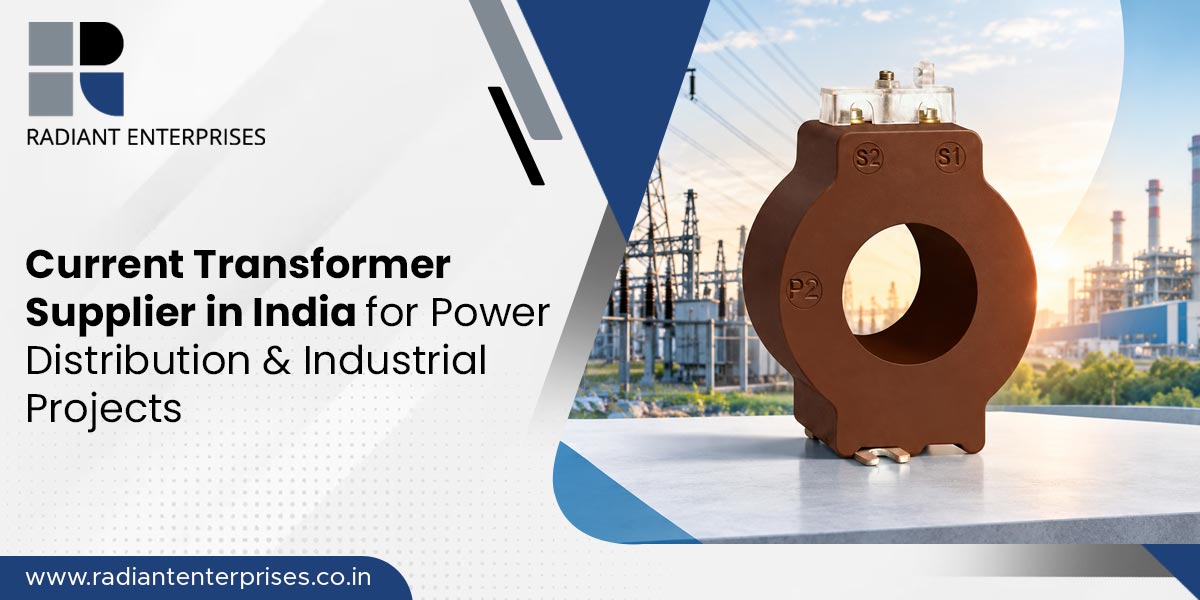
You may be planning a new panel, upgrading a substation, or replacing an old unit. The pressure often feels the same. One wrong choice can affect readings, relay action, and project dates. As a trusted current transformer supplier in India, Radiant Enterprises understands why buyers want clear answers before placing an order. We help you look beyond price and choose equipment that suits the real work on site.
At first, a CT can seem like one small part inside a much larger power system. Yet this part feeds vital current data to meters, relays, and control devices. A current transformer (CT) lowers a high primary current to a safe, known value. This lets connected devices read and act without direct contact with the main current.
We have seen projects face trouble because a unit was chosen from only one figure. The ratio matched, so the order seemed safe. Later, the meter lacked accuracy or the relay received a weak signal during a fault. As a current transformer manufacturer in India, we ask about the full duty before we suggest a design.
The needs of a billing meter differ from those of a protection relay. A metering core must remain accurate through its stated working range. A protection core must pass useful fault data without early saturation. At Radiant Enterprises, we keep this difference clear during product talks, drawing checks, and order reviews.
Across power distribution and industrial sites, common uses include:
Each use places a different demand on the product. Indoor switchgear may need a compact resin-cast unit. An outdoor yard may bring dust, heat, moisture, and long service hours. As a current transformer exporter in India, we also consider destination climate, packing needs, project documents, and local working conditions.
A current transformer (CT) must match both electrical duty and physical fit. Ratio, rated output, accuracy class, frequency, insulation level, and short-time current rating all matter. Window size, mounting space, terminal position, and cable route matter too. Radiant Enterprises reviews these points together because a correct rating still needs a practical installation.
You do not need to solve every design question alone. Still, having the basic project data makes discussion much faster. We usually ask you to confirm:
Burden is easy to miss. It covers the load from the connected device, lead wires, and terminals. If the real burden does not suit the selected unit, accuracy can suffer. As a current transformer manufacturer in India, Radiant Enterprises helps you review this detail before production, when changes are simpler and less costly.
A metering CT supports useful and fair readings during normal load. This matters for energy checks, process review, and billing. A protection CT faces a harder moment. During a fault, the current can rise very quickly. The relay still needs a dependable signal to decide when a breaker should trip.
This is where saturation becomes important. Once the magnetic core saturates, the secondary signal may no longer follow the primary current well. The relay can then receive a changed picture of the fault. We select the core and class with the full protection task in mind, not just the normal running current.
Radiant Enterprises also checks how the CT will work with the connected relay or meter. Cable length, lead size, terminal resistance, and device burden can change the total load on the secondary. A careful review now can prevent false readings, delayed trips, and long fault-finding work later.
It usually starts with something small, such as a loose terminal or an unclear label. At first, it may not seem serious. Yet a CT secondary must never be left open while primary current is flowing. A high and unsafe voltage may develop across the open secondary. Safe shorting, sound earthing, clear marks, and correct work steps are vital.
A current transformer (CT) also needs the right thermal and dynamic strength for possible fault current. Insulation must suit the voltage class and site setting. Radiant Enterprises builds quality checks around the agreed specification so each supplied unit can be traced back to its approved project details.
As a current transformer supplier in India, we support enquiries with a practical review of ratings, size, mounting, and use. We aim to reduce back-and-forth and catch gaps early. We also keep communication clear when a requested detail needs review, rather than letting doubt move into production.
For overseas projects, documents and packing carry extra weight. A current transformer exporter in India must understand that the product may pass through long transit, repeated handling, and varied storage conditions. We plan packing, identification, and dispatch records with care so your site team can receive and check the order with less stress.
Not every project can use a standard catalogue size. Existing panels may have tight space, fixed busbar centres, or unusual mounting holes. Some jobs need more than one core, special terminal positions, or project marks. At Radiant Enterprises, we welcome these talks early because a small drawing detail can shape the whole design.
As a current transformer manufacturer in India, we work from the agreed electrical and mechanical inputs. Custom work should never mean guesswork. Approved drawings, clear tolerances, and known test needs give both sides a firm base. This helps production move with fewer changes and gives your inspection team clear points to verify.
A single-line drawing, required ratio, class, burden, voltage, fault rating, dimensions, quantity, and delivery place form a strong start. Photos of an old unit can help with replacement work, but a readable nameplate and measured dimensions are still needed.
Yes. As a current transformer exporter in India, we can discuss technical documents, packing, inspection points, and dispatch needs for overseas orders. Clear destination and project terms help us plan the offer correctly from the start.
Choosing a CT should not feel like matching codes without knowing what sits behind each one. You deserve to know why a rating is suggested, what details still need checking, and how the unit will fit your system. That clarity gives engineers, purchase teams, and site staff more trust in the final choice.
Radiant Enterprises brings product knowledge and practical care to power distribution and industrial projects. Share your application, ratings, drawings, quantity, and site needs with us. We will help you review the key details and move towards a CT choice that feels clear, safe, and right for the work ahead.
Choose a ratio just above the highest working current. Also check expected load growth before finalising the ratio with your project engineer.
Metering CTs provide accurate readings during normal use. Protection CTs send fault current data to relays without saturating too early.
Share the ratio, accuracy class, burden, voltage, fault rating, core quantity, dimensions, installation type, required standard, and order quantity.
Accuracy class shows how closely the secondary output follows the actual primary current. The right class supports sound metering and relay response.
Burden is the total load connected to the CT secondary. It includes meters, relays, cables, terminals, and related resistance within the circuit.
Yes, one unit can contain separate metering and protection cores. Each core needs the correct class, burden, and output for its purpose.
Choose based on the place of use. Outdoor CTs need suitable protection against heat, moisture, dust, rain, and changing weather conditions.
Yes. We can assess window size, busbar spacing, mounting points, terminal position, ratings, and other limits before preparing a suitable design.
An open secondary can produce a dangerous high voltage while primary current flows. Always use safe shorting and earthing steps during maintenance.
IEC 61869-2 covers key requirements for inductive CTs used with meters and protection devices. Your project may also require added tests or standards.
Nameplate details provide a useful start, but dimensions and connected devices must also be checked. Share clear photos, drawings, and measured sizes.
Check product knowledge, test support, drawing approval, custom options, past supply work, delivery terms, packing quality, and response speed before ordering.